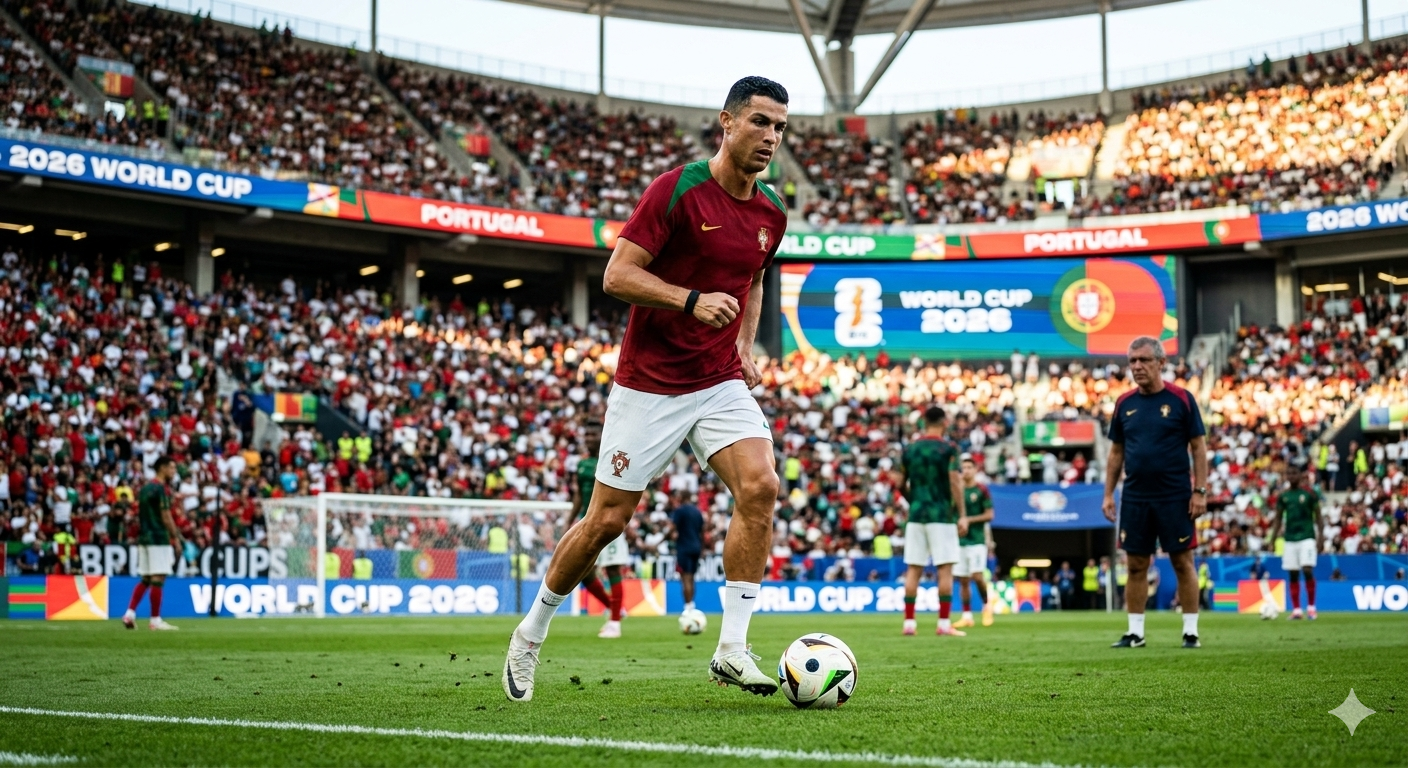
The 2026 World Cup is underway, and football legend Cristiano Ronaldo is relying on a hidden tech tool to maintain his peak physical dominance. Fans and sports analysts have frequently spotted a minimalist black band on Ronaldo’s wrist during training. Lacking a screen, notifications, or traditional smartwatch features, this device is being hailed by sports scientists as one of the most advanced health-tracking technologies in the world today.
The device is Whoop, a cutting-edge health wearable developed by a US-based technology firm. Ronaldo is not just a daily user; he is also one of the company’s most high-profile investors. As the 41-year-old Portuguese icon competes on the world stage, Whoop remains a core part of the data ecosystem supporting his intense training and recovery cycles.
Why Top Athletes Choose Whoop Over Smartwatches
Unlike conventional smartwatches that constantly battle for user attention with screens and push notifications, Whoop operates quietly in the background. Its primary philosophy is continuous, uninterrupted data collection.
This distraction-free approach has made it a favorite among global sports icons, including:
LeBron James (Basketball)
Michael Phelps (Swimming)
Aryna Sabalenka & Carlos Alcaraz (Tennis)
Advanced Biometrics: How the Data Works
Whoop utilizes a highly sophisticated sensor array to track critical biometric markers 24/7. The device monitors:
Heart rate and Heart Rate Variability (HRV)
Skin and body temperature
Respiratory rate and daily physical exertion levels
Sleep architecture and overall sleep quality
All collected data is fed into an advanced mobile application that translates raw biometrics into three actionable scores: Recovery, Strain, and Sleep.
The World Cup Sleep Coach: Combating Jet Lag
One of Whoop’s standout features is its automated Sleep Coach. Instead of simply tracking when a user falls asleep, the feature calculates personalized rest requirements by analyzing the previous day’s physical exertion and baseline cardiovascular recovery.
This technology has become standard infrastructure at the 2026 World Cup. For example, the England National Team has officially equipped its players with Whoop bands to manage sleep quality amid a grueling match schedule. Traveling between different host cities and time zones takes a heavy toll; Whoop’s data indicates that long-distance flights and jet lag can degrade sleep quality by up to 6%, directly hurting on-field performance.
Defying Age: Tracking Biological Decline
At 41 years old, Ronaldo’s ability to sustain elite athletic performance is heavily tied to tracking his biological age rather than his chronological age. Whoop has recently upgraded its algorithms to assess long-term biometric trends, allowing athletes to monitor signs of physical decline over months and years.
According to Dr. Andy Galpin, a prominent scientist specializing in Human Performance and Bioenergy, the true power of the device lies in data translation.
“The greatest advantage of devices like Whoop lies not in providing more data, but in their ability to translate that data into concrete action.”
Instead of training based on raw intuition or feeling, elite athletes can open the app to know the exact metabolic state of their body—allowing them to make precise adjustments on whether to push harder or prioritize rest.